
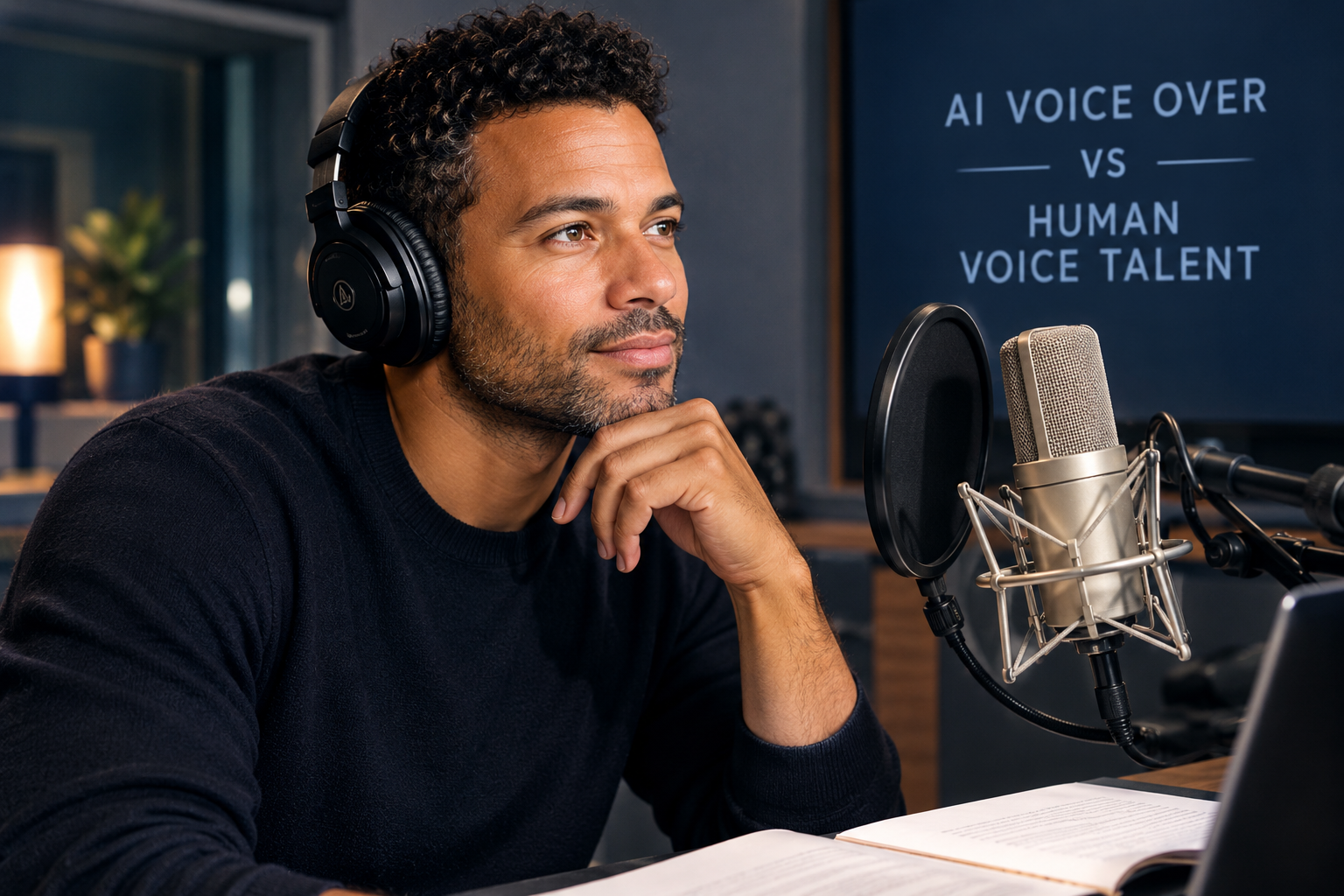
You’ve probably already had this conversation internally. Someone on the team ran a script through a synthetic voice tool. The result came back faster and cheaper than expected. Now there’s a real question on the table about which projects still need a human in a booth.
It’s a fair question. And the AI voice over vs human decision comes down to one thing: what the audio is actually doing for your brand. It has very little to do with arguments about authenticity.
I’ve narrated commercial and corporate work for over seven years. My clients include Google, Amazon, Apple, BMW, Porsche, Deloitte, Dell, and Salesforce. Over the past two years, I’ve also watched a lot of those clients navigate this exact decision. Some made the right call going synthetic. Others spent real money finding out they’d made the wrong one. Here’s the framework I’d use if I were sitting on your side of the table.
WHERE AI VOICE OVER GENUINELY MAKES SENSE
Let’s start here, because pretending otherwise would waste your time.
Synthetic voice has gotten good at a specific set of jobs. If your project falls into one of these categories, hiring a human may be an unnecessary expense.
Internal training modules and compliance content. Say it’s going to an internal audience. The script updates quarterly. Nobody outside your company will ever hear it. Synthetic voice is a reasonable choice here. Re-recording every policy change with human talent adds up fast, and your employees are not judging your brand by the narration.
Scratch tracks and animatics. Almost every agency I work with uses synthetic voice for timing passes now. It’s faster than booking talent for a rough cut. It also lets the creative team hear pacing before anyone commits to a direction. This is genuinely good workflow, and I’d recommend it.
High-volume content at scale. Think product description audio across thousands of SKUs. Automated notifications. Dynamic content that changes per user. No human can economically voice ten thousand variants, and no listener expects artistry from a shipping confirmation.
Accessibility and utility functions. Screen readers, navigation prompts, and similar functional audio. The job is clarity, not character.
Does your project live in one of those buckets? Then you have my blessing. I’d rather tell you that honestly than pitch you on something you don’t need.
Not sure which bucket you’re in? Send me your script and I’ll tell you straight.
WHERE AI VOICE OVER STARTS COSTING BRANDS MONEY
Here’s the part that gets expensive. And it’s rarely about the audio quality itself.
The problem shows up where the voice carries something other than information. Sometimes a voice needs to make someone feel a specific way. Sometimes it has to hold attention through a story. Sometimes it becomes a recognizable part of how your brand sounds. In those cases, synthetic voice tends to underperform. And the gap doesn’t show up until the work is already out in the world.
Interpretation is the piece that doesn’t transfer. A good read isn’t just correctly pronounced words at the right pace. It’s a performer making hundreds of small decisions. What matters in this sentence? Where do I lean in? What do I throw away? What is this line actually about underneath the words?
Synthetic voice can replicate the surface of that, and it increasingly does it well. But it can’t make those choices, because it doesn’t know what the line means.
That matters most where the audio is the product. Brand campaigns. Narrative advertising. Anything with humor, which is almost entirely about timing. Anything emotional, where being slightly wrong is worse than being flat. Character work, where a performance has to stay consistent across dozens of sessions.
AI VOICE OVER VS HUMAN: WHAT BRANDS SHOULD ASK FIRST
Rather than arguing the philosophy, here are the questions I’d actually run through.
Is the voice carrying the brand, or just carrying information? If someone could read this as text and lose nothing, synthetic is fine. If the delivery does work the words alone don’t do, you want a performer.
How long will this asset live? A two-week social campaign carries very different risk than a brand platform running for three years. The longer something lives, the more it matters that it holds up.
Will this voice need to stay consistent across future work? This is the one people miss. Build a brand around a synthetic voice, and you’re building on a specific vendor’s model. Those models get updated, deprecated, and repriced. Human talent can be re-booked in five years. A model version often can’t.
Who is the audience, and what will they notice? B2B buyers evaluating a six-figure purchase notice more than you’d expect. Consumer audiences on a fifteen-second social spot notice less.
What’s the cost of getting it slightly wrong? If a flat read costs you nothing, use whatever’s fastest. If a flat read costs you a campaign’s momentum, that math changes completely.
Weighing a specific project against those questions? Let’s talk about it. I’ll give you an honest read on whether you need me.
THE LICENSING QUESTIONS MOST BRANDS DON’T ASK EARLY ENOUGH
This is where I’d spend your attention. It creates actual legal and operational exposure, and it’s usually handled last.
With human talent, usage is well-understood territory. You license a defined scope for a defined term. Everyone knows what happens at renewal.
Synthetic voice is messier. Terms vary widely between providers. Here’s what to confirm before you build anything on a synthetic voice.
First, what was the voice trained on? Did the humans behind it consent, and were they compensated? This is becoming a genuine reputational question, not just an ethical one. Several jurisdictions are actively legislating in this space.
Second, what happens if the provider changes or retires the voice? If your brand identity depends on a specific synthetic voice, you want contractual clarity on availability. Current pricing isn’t enough.
Third, are your usage rights actually perpetual? Or are they perpetual until the terms of service change?
Fourth, do any regional restrictions apply? Some jurisdictions have significantly stricter biometric and voice-likeness laws than others. If you’re running campaigns across North America and Europe, those differences matter.
None of this makes synthetic voice a bad choice. It just means the diligence looks different from what your team is used to. And it’s better done before the campaign than during it.
WHY SOME BRANDS NOW CHOOSE HUMAN VOICE TALENT MORE DELIBERATELY
Something interesting has happened as synthetic voice became common. The presence of a real performance now reads as a signal in itself.
When a category fills up with competent, slightly generic audio, a specific human voice stands out simply by being specific. That’s not nostalgia. It’s contrast. For premium brands especially, sounding like a person rather than a product is becoming part of the positioning.
I’ve seen this most clearly with European clients. In my experience, they tend to raise provenance and talent consent questions earlier than North American clients do. But it’s showing up on both sides of the Atlantic now.
Working with me looks the same regardless of where your team sits. My studio runs a Neumann TLM 103 through a Focusrite Clarett, with Source-Connect for live remote direction. An agency in Toronto, London, or Milan can direct the session in real time and have broadcast-quality files the same day. Time zone hasn’t been a meaningful obstacle in years.
Get a custom quote for your project. I’ll include turnaround and usage terms up front, no guessing.
A PRACTICAL WAY TO SPLIT YOUR VOICE OVER BUDGET
The brands handling this well aren’t choosing one or the other. Instead, they sort their audio by what it’s doing.
Synthetic voice handles the volume work. Internal content, scratch tracks, functional audio, high-variant content. Anything where the job is clarity and speed.
Human talent handles the work that carries the brand. Campaign spots, brand platforms, narrative content. Anything with humor or emotional weight. Anything heard by the people whose opinion determines whether they buy.
Handled this way, the AI voice over vs human question stops being all-or-nothing. That split usually frees up more budget for the work that matters, not less.
FREQUENTLY ASKED QUESTIONS
Is AI voice over better than human voice over?
Neither is universally better. Synthetic voice suits internal training, scratch tracks, functional audio, and high-volume content where clarity is the goal. Human talent performs better where the read carries emotion, humor, brand identity, or narrative. Interpretation and timing are performance decisions, not technical ones.
When should a brand use AI voice over instead of hiring a voice actor?
Use synthetic voice when the audio is informational, internal, frequently updated, or needed at a volume no human could economically record. Hire a voice actor when the delivery does work the words alone can’t do. The same applies when the asset will live a long time, or when the voice needs to stay recognizable across future campaigns.
What are the licensing risks of using AI voice over?
The main risks are unclear training data provenance and uncertain long-term availability of a specific voice. Usage rights can also change with a provider’s terms of service. On top of that, biometric and voice-likeness law varies by region. These are worth resolving before a campaign is built, not during it.
Can AI voice over replace a brand’s signature voice?
Technically it can produce consistent output. However, it introduces vendor dependency. If a provider updates, reprices, or retires a model, a brand identity built on that voice becomes difficult to maintain. Human talent can be re-booked years later, which makes it the more durable choice for long-running brand work.
Do European and North American brands approach AI voice over vs human talent differently?
In my experience, European clients and agencies raise questions about training data, talent consent, and provenance earlier in the conversation. That partly reflects a stricter regulatory environment. North American clients increasingly ask the same questions, just often later in the process.
Working through this decision for a specific project? Send me the script and the usage details. I’ll tell you honestly whether it’s a job for a human or one you can handle synthetically, and give you a clear quote either way.